
First Timer’s Guide to Agile Mobile Development: Exploring the different phases of mobile app development
Learn moreSwipe to Check More
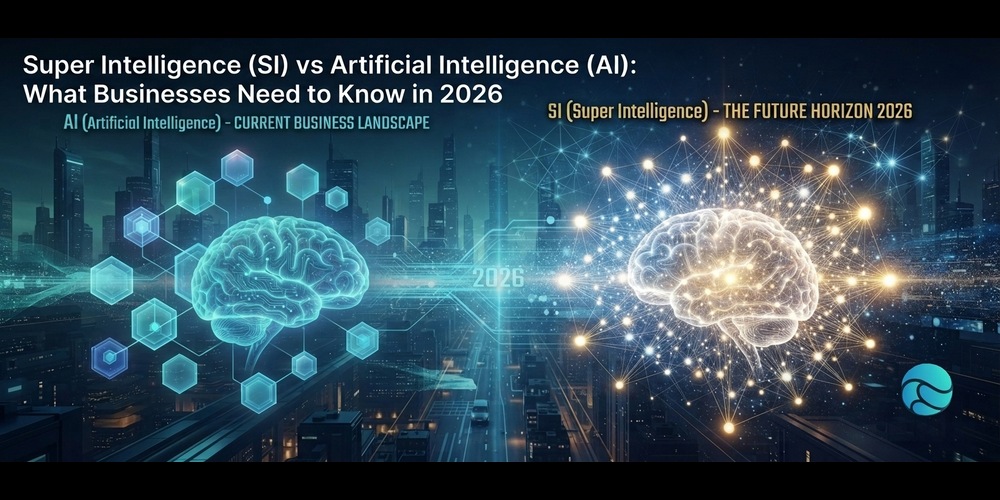

One of the largest disruptions to the technology landscape in the last 10 years has been Artificial Intelligence (AI). Now, in 2026, a new term is getting a lot of attention: Super Intelligence (SI).
This isn’t just changing the name of AI. This term highlights the way that AI systems are quickly increasing in capability, autonomy and generally positive business and technology impact.
In September 2026, President Biden issued Executive Order 14434, titled Inaugurating the Era of Super Intelligence. The order outlines the need for the federal government to create a working definition of the term “Super Intelligence” and directs federal agencies to begin documenting methods to safeguard and protect national interests from advanced AI systems.
While companies should consider the Executive Order and general trend towards Super Intelligence, they should be cautious with the terminology. SI can mean many different things to many different people. In the United States, Super Intelligence is a new term for advanced artificial intelligence systems. In general, research and other literature describing Super Intelligence refers to artificial intelligence that is beyond human cognitive capabilities.
From a business perspective, the more pressing question is, how should a business respond to the increasingly capable AI?
Additionally, what potential threats, and opportunities, do increasingly capable AI systems create for business?
Generative AI, ML, conversational AI and other forms of business AI, are not science fiction.
Businesses should be focused on practical, use cases, data, quality, control, governance, oversight, and measurable outcomes (ROI) rather than misleading AI terminology.
Businesses should expect steady improvement and increasing intelligence in workflows across software development, automation, customer service, analytics, and business decision support systems.
The term SI has several significant meanings, and that meaning depends on the context. In the U.S. policy discussions for 2026, SI will be associated with advanced Artificial Intelligence (AI) systems. In science, superintelligence refers to a high-level intelligence that will be capable of surpassing human intelligence.
The distinction is important because the term SI creates confusion.
A business reading “Super Intelligence” may believe that AI has been suddenly replaced with a totally new technology. This is not the case in the terminology shift that is occurring. The terminology shift is happening alongside rapid advances in the frontier of AI and other intellectual technology systems.
The systems becoming more advanced are capable of reasoning and interacting with humans through various modalities, in addition to planning, autonomously using tools, and coding.
Executive Order 14434 states that the frontier systems of today go beyond what was originally envisioned when the term Artificial Intelligence was coined and directs efforts to create a definition of “Super Intelligence.
The inclusion of SI in the 2026 U.S. policy discourse signals a shift toward the next phase in the development of Artificial Intelligence.
It does not mean that every system has become superintelligent.
Rather, the term reflects a discussion on the direction in which the technology may evolve.
This is important for CXOs to consider because the pace of technological shifts may cause companies to change their investment rationale.
A company that previously asked:
“How can we add AI to our business?”
may increasingly ask:
“How can increasingly autonomous and capable intelligent systems become part of our business operations?”
That is a much more useful question.
In an academic or industry discussion, when people say they are discussing superintelligence, they are often referring to a system which can outperform humans across almost all cognitive activities, including but not limited to reasoning, scientific thought, planning, programming, creative discovery, research, and other activities.
This cannot be equated to enterprise AI.
A company using a chatbot to answer customer questions is using enterprise AI
A company using an AI system to analyze different types of documents is using enterprise AI
A company using an AI system to execute an administration-controlled workflow is using a highly advanced agentic AI system.
By themselves, none of the above mentioned scenarios would mean that the system is, in fact, “superintelligent.”
This is an important distinction from a reliable technology communication point of view.
The term “super intelligence” first became popular after the U.S. Executive Order 14019 was issued on September 29, 2026, “Inaugurating the Era of Super Intelligence.” The Order outlines the new revolution in intelligence technologies, and proposes the first federal definition of “super intelligence” and “SI.”
There is also an ongoing broader discourse concerning terminology, technology and policy, Artificial Intelligence (including, e.g., business and employment implications), and where the edge is for intelligent systems.
There is also evidence to show the renewal is occurring in the technology industry. Reuters reported on October 4, 2026 that Elon Musk, stated that SpaceX would rename its AI division from SpaceXAI to SpaceXSI to reflect the new terminology.
However, businesses are cautioned not to believe that the acronym “SI” represents a new generation technology that is available for purchase and sale.
The underlying technologies still include familiar areas such as:
The bigger change is the capability, autonomy, integration, and scale of these systems.
For businesses, that distinction is more important than the label.
The simplest way to understand the difference is to look at the terms in context.
| Factor | Artificial Intelligence (AI) | Super Intelligence (SI) |
|---|---|---|
| General meaning | Broad field of machine-based intelligence | Advanced term with different policy and technical meanings |
| Commercial use | Already widespread | Still an evolving concept |
| Current applications | Chatbots, analytics, recommendations, automation, computer vision and more | Associated with increasingly capable intelligent systems |
| Autonomy | Varies by system | Often associated with much greater autonomy in future-oriented discussions |
| Human performance | Can match or exceed humans in specific tasks | Technical concept generally implies broad superiority over humans |
| Business adoption | Mature and growing | Emerging terminology and future-oriented discussion |
| Status in 2026 | Widely deployed | Policy term is emerging; technical superintelligence remains a much stronger concept |
The key thing is AI and SI should not be shown as competitors.
AI is a wide technological area.
SI, depending on the context, may mean the current policy frameworks advanced AI or a far more advanced concept.
For businesses, the practical progression is more useful:
AI --> Generative AI --> AI Agents --> More Autonomous AI Systems
This represents what businesses can actually implement in the market today.
No, AI, AGI, ASI, and SI are related concepts, but shouldnt be interchanged.
Artificial Intelligence is the broadest category.
As discussed, the term AI generally refers to the use of computer systems to perform intellectual tasks traditionally performed by humans.
Some of these tasks include:
The types of AI systems used by companies today generally fall within this definition.
AGI systems cover systems that perform tasks requiring broad, general-purpose intelligence and are not very task-specific as are other forms of intelligence. -
There is currently no single, well-accepted, and objective, threshold that can be used to determine if a system has become AGI.
ASI refers to systems that can perform intellectual tasks broader than that of humans.
This is a stronger concept than an AI system that performs a business function extremely well.
Because of the 2026 U.S. executive order, there is currently an additional policy consideration for SI.
The executive order directs various federal agencies to propose a definition for Super Intelligence and SI, meaning that the terminology is still developing in the policy environment.
Therefore, entities should look at context when interpreting SI.
Super-intelligent software is probably the biggest business opportunity this century. Fiction often makes the mistake of focusing on physical-world changes rather than software and AI changes. For many businesses, the future is likely to be a gradual, iterative improvement in software that reads and writes more information and automates business workflows.
This trend is likely to affect numerous business functions.
Traditional automation generally follows predefined rules.
For example:
If a customer submits form A, send email B.
AI-powered automation can be more flexible.
An intelligent system may be able to:
This does not mean that humans should not be involved in business processes. It suggests that intelligent systems can reason over data and automate the process of performing actions as well as use business rules to decide when to escalate a case to a human.
Businesses generate enormous quantities of information.
Sales teams have customer data.
Finance teams have transaction records.
Marketing teams have campaign data.
Operations teams have workflow data.
Customer support teams have conversations and tickets.
Advanced AI systems can help transform these data sources into useful insights.
Examples include:
The best solutions on the market arent chatbots.
They can integrate with your CRM, help desk, order management systems, and other business apps.
This allows the AI to be embedded within the workflow instead of being confined to a chat window.
AI has changed the way software is developed. Some ways AI can help developers include:
Writing code
Explaining code
Finding bugs
Writing tests
Analyzing and writing documentation
Refactoring code
Generating technical docs
Accelerating prototype development
There are a number of limitations including the need for engineering oversight when using AI to write code.
The long-term possibility is not to replace software developers with prompts. Instead it is to let developers focus on larger issues like architecture and product decisions, rather than small coding tasks.
AI agent technology has the potential to rapidly evolve the use cases of AI across many industries.
Traditionally, an AI system has the capability to answer a question.
An AI agent can have a goal and reason about what steps are required to achieve that goal and can take actions to achieve that goal and report the result.
Lets consider an example of sales workflow.
A traditional AI system or a chatbot can answer the question "What products are available?"
The key word here is “may be able to”.
AI agents must be programmed with clear permissions and within security limits. Human oversight must be incorporated.
Currently at Corewave, our AI agent development services include building custom AI agents, integration of AI agents with CRM, ERP, and HRM, and other services such as adaptation of LLMs, RAG and MCP, and LangChain and LangGraph.
This gives businesses the ability to build intelligent automation workflows, even without waiting for the predicted advanced version of AI.
AI agents can be designed for different business functions.
Sales agents can assist with:
Support agents can:
Research-oriented agents can help teams:
Operational agents can support:
Depending on the risk level and governance requirements, AI systems can support:
High-impact financial decisions should still include appropriate controls and human review.
This information is useful for business leaders.
Traditionally, chatbots are developed for conversations.
AI agents are developed with goals and actions in mind.
A chatbot may answer the question “What is the status of my order?”
An agent could find the order status and notify you of the answer.
For advanced workflows, the agent is capable of:
The difference is not that one system is “smarter.”
The difference is in what the software is permitted to do and what the software is designed to do.
That is why the control and the monitoring of the identity and access to enterprise systems becomes crucial as the AI systems become smarter.
Businesses do not need to wait for theoretical superintelligence to benefit from advanced AI.
There are already practical use cases across industries.
AI can support:
Sensitive healthcare applications require appropriate privacy, security, validation and regulatory controls.
AI can support:
AI can improve:
AI can support:
AI can help with:
AI applications can support:
The opportunity is not limited to one industry.
The strongest AI implementations are usually the ones that solve a specific operational or customer problem.
More powerful AIs present more opportunities but increase the risk of mishaps due to irresponsible use.
Hallucinations
AIs may provide wrong or misleading answers.
Responses may appear convincing, but that doesnt mean the answer is right.
In cases where correct answers are required, a validation mechanism should be used.
Data Privacy
There may be sensitive data involving the business or the customer.
Appropriate:
When a system is allowed to take more actions, permission and control become even more important.
AI should not have free access to all business systems.
Permission should be:
There may be other security threats due to connectivity to external sources.
Businesses must think about how untrusted inputs can affect model behavior.
Over-Automation
Not every workflow should be automated.
Some decisions require:
There must be appropriate automation, not maximum automation.
Compliance
Certain regions and industries have different compliance rules.
A business creating AI for regulated industries, like finance or healthcare, should consider regulatory and compliance requirements from the start.
Our AI development services consider compliance and security requirements, including GDPR and HIPAA.\
Businesses dont necessarily need to rebuild everything right away.
A good starting point is to take an inventor approach with business problems.
Which tasks do employees repeat?
Examples include:
Answering repetitive questions
Document processing and data entry
Report generation and CRM data entry
Ticket classification and triage
These can be great starting points for automation.
AI is as good as the information and systems surrounding it.
Review your:
Data quality
Data accessibility
Data ownership and control
Data loss prevention (DLP)
Integration
For some use cases, the right architecture might be:
Traditional automation
RAG
Computer vision
Natural Language Processing (NLP)
Generative AI
AIs
The combination of technologies
Focus on optimizing a single business process.
Measure:
time
cost
accuracy
response time
conversion
Satisfaction
productivity
Decide whether a workflow requires multiple steps, tool use, or contextual decision-making.
But establish boundaries for the agent.
Leave human review in place for processes where mistakes can result in serious harm.
Define:
who can access the system
what data the AI can access
what the agent can do
when an approval is needed
how activity is logged
how incidents are handled
2. Measure Return on Investment (ROI)
There must be a return on the investment of AI adoption.
A project that uses an advanced model to gain media attention is not a successful AI project.
Treating this as a simple choice between AI and SI is a mistake for businesses.
Invest in capabilities, not terminology.
For companies struggling with customer support, they can look to use conversational AI.
For companies with workflows that involve repetitive document processing, they can look to use document processing AI.
For companies that have employees spending a large amount of time researching, they can use an AI research assistant or agent.
For companies that have multiple disconnected systems and apps, they can use AI integration to create greater system and app value.
For software development teams looking to create and build applications faster, they can use AI to develop software at an increased pace.
The main question businesses should consider is:
Which business problem can intelligent software solve better, faster or more efficiently?
This main question will remain relevant, regardless of what terminology is used to describe it (i.e. AI, SI, Agentic AI, AGI, etc).
Creating a profitable AI-powered system is more than picking an AI model.
usinesses need:
Corewave offers a variety of AI software development services. These include, but are not limited to, AI consulting and strategy, generative AI, AI agents, conversational AI, AI integration, AI MVP development, AI cybersecurity, AIOps, model fine-tuning, and end-to-end AI software development.
Corewave’s services also include AI agent development including custom agent building, integration, and fine-tuning.
The company works on a variety of AI application development projects, including generative AI, machine learning, NLP, computer vision, and AI-SaaS.
Understanding the business problem is the first step.
Corewave evaluates a company’s workflows, data, and processes to highlight opportunity areas where AI can provide value.
This helps businesses evaluate where AI can provide value, if at all.
AI should be strategic.
There are many areas in a business where custom AI can be designed and built to help:
Custom AI software can be designed around:
Generative AI can support applications involving:
For enterprise applications, reliability and context are especially important.
AI agents can help businesses automate multi-step workflows.
They can potentially interact with:
The purpose is not to develop AI that results in completely autonomous systems.
The end goal is intelligent systems which derive actionable business insights.
In some cases, integrating AI into existing systems is a better option than implementing a completely new software platform.
Corewave offers AI integration services as part of its AI software development services.
Domain-specific AI experiences require contextual interactions and business process automation.
Corewave offers various products including content automation tools, data insights, AI chatbots, and other security-focused applications powered by LLMs.
Names in tech will continue to change.
AI was once a relatively unheard of term that has now taken center stage.
Generative AI burst onto the scene not long ago.
Agentic AI will only continue to increase in popularity.
Super Intelligence will also continue to change and evolve in public and policy discourse.
There will probably be more terms coined in the near future.
This means companies should structure around capabilities and not names.
There are a variety of features of a strong tech strategy including:
A company that establishes these foundations will be prepared for whatever the next major term in AI is.
Super Intelligence (SI) has different meanings depending on context. In the 2026 U.S. policy discussion, it is an emerging term associated with advanced AI technologies. In technical AI discussions, superintelligence generally refers to a hypothetical form of intelligence that could exceed human capabilities across a broad range of cognitive tasks.
No, not necessarily. Artificial Intelligence is the broad field of technologies that perform tasks associated with human intelligence. Super Intelligence can refer to a policy term for advanced AI or, in technical discussions, a hypothetical level of intelligence that would broadly surpass human capabilities.
The term became prominent following the September 29, 2026 U.S. Executive Order 14434, Inaugurating the Era of Super Intelligence. The order calls for work toward a federal definition of “Super Intelligence” and “SI.”
This depends on what is meant by the term. Advanced AI systems are real and widely deployed, while the technical concept of a machine intelligence that broadly surpasses humans remains a much stronger and more speculative concept. The current use of SI in U.S. policy should not automatically be interpreted as proof that technical superintelligence has been achieved.
No. AGI generally refers to a hypothetical form of AI with broad general-purpose capabilities. SI may refer to advanced AI in the current policy context, while technical superintelligence generally describes a much higher level of capability.
Not necessarily. ASI, or Artificial Superintelligence, is generally used for a hypothetical intelligence that broadly exceeds human intelligence. SI has acquired a separate policy meaning in the 2026 U.S. discussion
More capable AI systems could improve business automation, software development, customer service, analytics, decision support, research and workflow management. Businesses can already implement many of these capabilities using generative AI, machine learning and AI agents.
Businesses can already use advanced AI technologies, including generative AI, AI agents, machine learning and AI-powered applications. However, businesses should avoid assuming that todays commercial AI systems are technically equivalent to hypothetical human-surpassing superintelligence.
AI agents represent a practical move toward more autonomous software. Unlike systems that only generate responses, agents can be designed to interpret goals, use tools, retrieve information and execute controlled tasks. They are one of the important technologies businesses can use today while the broader SI conversation continues to develop.
Businesses should evaluate AI based on practical use cases rather than terminology. Good starting points include repetitive workflows, customer service, document processing, analytics, software development and decision support. Companies should also consider data quality, security, compliance, human oversight and measurable ROI.
There are many nuances to the discussion around super intelligence (SI) vs artificial intelligence (AI). However, the main point of discussion is around the evolution of software.
AI systems are evolving to the point of understanding and analyzing language, creating content, interpreting and reasoning with data, interacting with tools, and ultimately, partaking in business workflows. AI systems are combining with the Internet of Things and other edge computing devices to form a fabric of intelligent systems and agents throughout the business.
Weve already begun to see how Generative AI changes how content is created and consumed. We are just beginning to see how AI changes how software is created and consumed.
This evolution will continue and intelligents systems will extend across applications, data, and business processes.
There is no need to wait for a hypothetical superintelligence future to make changes to business processes and practices.
The opportunity is now.
Businesses should begin to implement practical applications of AI and other automation where it makes sense. A controlling intelligence system, often managed and protected by the business itself, will foster the necessary environment for the software systems to evolve in alignment with customer and business needs.
If your business is thinking about AI and automation, let the experts at Corewave take your ideas and create production-ready solutions.